
Newsom v. Trump
Legal Issues
BrynoDC Coverage 8 videos
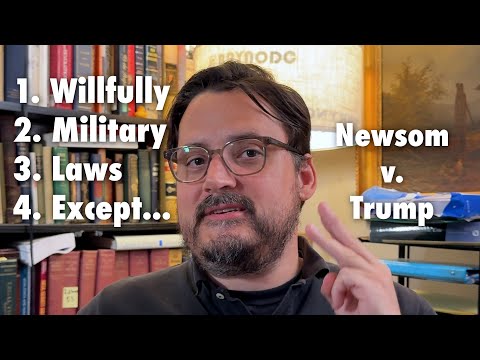

Overview
Overview
California Governor Gavin Newsom filed suit against the Trump administration in 2025, challenging executive actions that the State of California contends exceed federal authority or unlawfully coerce the state in violation of constitutional principles of federalism and the Spending Clause. The case is one of dozens of multi-state and gubernatorial lawsuits challenging the Trump administration's second-term agenda.
The Facts
Facts
California Governor Gavin Newsom initiated litigation in the Northern District of California targeting Trump administration executive actions affecting California's federal funding streams, regulatory relationships, or immigration enforcement cooperation. California has historically resisted federal immigration and environmental enforcement through state sanctuary policies and has been a frequent litigation target and plaintiff in federal courts challenging federal executive authority.
The Issue
Issue
Whether the Trump administration's executive actions conditioning federal funding or directing state cooperation with federal programs violate the anti-commandeering doctrine, Spending Clause limitations, or separation of powers principles as applied to California.
The Rules
Rule
Under the anti-commandeering doctrine (Murphy v. National Collegiate Athletic Association, 584 U.S. 453 (2018); Printz v. United States, 521 U.S. 898 (1997)), Congress may not commandeer state executive or legislative officials to enforce federal programs. Spending Clause conditions must be unambiguous, related to the federal interest in the program, and not unduly coercive (South Dakota v. Dole, 483 U.S. 203 (1987); NFIB v. Sebelius, 567 U.S. 519 (2012)). States retain sovereign authority under the Tenth Amendment to decline cooperation with federal regulatory schemes.
The Application
Analysis
California challenges the executive actions as violating the anti-commandeering doctrine by conditioning federal funding on state cooperation with federal immigration enforcement, effectively requiring state officials to implement federal policy in violation of Printz and Murphy. Under Spending Clause scrutiny, any such conditions must be unambiguous and related to the federal program's purpose, but, critically, they cannot be unduly coercive, particularly when withholding substantial independent federal funding. The court must resolve whether these executive actions fall within the permissible scope of conditional spending (which states may decline) or constitute impermissible commandeering of California's sovereign law enforcement discretion, a distinction sharpened by California's established sanctuary policies that reflect deliberate state choices about resource allocation and priorities.
The Conclusion
Conclusion
Pending resolution. The case is part of a broader wave of constitutional litigation between California and the federal government over executive overreach, federalism limits, and the scope of presidential authority in the Trump administration's second term.
Flag an issue
This tracker is maintained by BrynoDC and is free because readers fund it. Support