
Newsom, et al v. Trump, et al. (Nat Guard appeal, 9th Cir. 25-5553)
Case Overview
The government's Ninth Circuit appeal (No. 25-5553) from Judge Charles Breyer's ruling that the Trump administration violated the Posse Comitatus Act by deploying the California National Guard and U.S. Marines to Los Angeles during the summer 2025 immigration-enforcement protests. The appeal is currently held in abeyance while the Ninth Circuit resolves related appeals over the President's authority to federalize the Guard.
President Trump federalized the California National Guard under 10 U.S.C. Section 12406(3), and the administration deployed roughly 4,000 Guard members and 700 Marines to Los Angeles amid protests over immigration raids.
Governor Newsom and the State of California sued before Judge Breyer in the Northern District of California and won a temporary restraining order returning control of the Guard, but the Ninth Circuit stayed that order, finding the President had likely acted within Section 12406(3). (Newsom v. Trump, 141 F.4th 1032 (9th Cir. 2025).)
After a three-day trial, Judge Breyer ruled in a 52-page opinion that the administration had willfully violated the Posse Comitatus Act by systematically using armed soldiers and military vehicles for law-enforcement functions such as perimeters, traffic blockades, and crowd control, and enjoined further such use of the military in California. He stayed the injunction until September 12 to allow an appeal, and did not order the roughly 300 remaining troops to leave.
The government appealed Judge Breyer's Posse Comitatus judgment to the Ninth Circuit (No. 25-5553).
The Ninth Circuit ordered this appeal held in abeyance pending resolution of the related appeals (Newsom v. Trump, Nos. 25-3727), which concern the President's federalization authority under Section 12406.
California filed its most recent status report; the appeal remains in abeyance.
Legal Issues
BrynoDC Coverage 12 videos
 TikTok
  TikTok TikTok
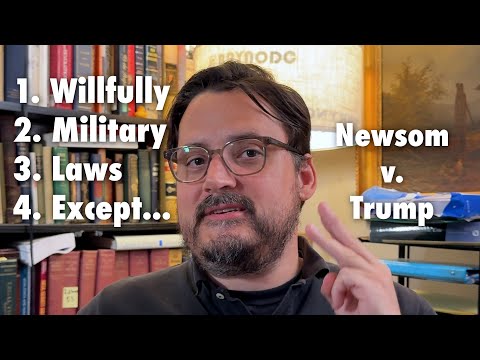 YouTube TikTok TikTok TikTok TikTok TikTok
  TikTok
 The Facts
In June 2025, following protests in Los Angeles over federal immigration raids, President Trump federalized the California National Guard under 10 U.S.C. Section 12406(3), and the administration deployed roughly 4,000 Guard members and 700 Marines to the Los Angeles area. Governor Newsom and the State of California sued (ultra vires, Tenth Amendment, and Administrative Procedure Act claims). Judge Charles Breyer granted an early temporary restraining order returning control of the Guard, which the Ninth Circuit stayed, finding the President had likely acted within Section 12406(3).
After a three-day trial in August 2025, Judge Breyer ruled on September 2, 2025 that the deployment violated the Posse Comitatus Act and enjoined the administration from using the military for domestic law-enforcement functions in California. The government appealed that judgment to the Ninth Circuit (No. 25-5553), which has held the appeal in abeyance.
The Issue
Whether the Posse Comitatus Act applies to National Guard troops federalized under 10 U.S.C. Section 12406(3), or whether that federalization statute is an exception that removes them from the Act's reach; and whether the summer 2025 deployment used the military for prohibited domestic law-enforcement functions in violation of the Act. As a procedural matter, whether this appeal should proceed now or await the Ninth Circuit's resolution of the related appeals over the federalization itself (Nos. 25-3727).
The Rules
It is a crime to use the Army or Air Force to execute the laws (domestic law enforcement) except in cases expressly authorized by the Constitution or Act of Congress.
The President may call the National Guard into federal service when the United States is invaded, there is a rebellion, or the President is unable with the regular forces to execute the laws.
Powers not delegated to the federal government are reserved to the States, including a State's control over its own National Guard absent a valid federalization.
The Application
California argued, and Judge Breyer agreed after trial, that the evidence showed the military was used for classic law-enforcement tasks, setting up perimeters, blocking traffic, and controlling crowds, which the Posse Comitatus Act forbids, and that 10 U.S.C. Section 12406 lets the President call up the Guard but does not license troops to enforce the law once called up. Breyer rejected the administration's reading of Section 12406(3) as an exception to the Act, warning it would "nullif[y] the act itself," and found the violations willful because the deployment contradicted the military's own training materials.
The government contends that Section 12406(3) authorized the deployment (a point the Ninth Circuit found likely when it stayed Breyer's earlier order) and that troops called into federal service to protect federal personnel and property are not barred by the Posse Comitatus Act. Because the scope of the President's federalization power is squarely presented in the related appeals, the Ninth Circuit has paused this Posse Comitatus appeal until those are decided.
The Conclusion
The Posse Comitatus appeal is on hold. The Ninth Circuit has held No. 25-5553 in abeyance pending its decision in the related appeals over the President's authority to federalize the California National Guard (Nos. 25-3727). Until those are resolved, Judge Breyer's ruling that the deployment violated the Posse Comitatus Act, and the injunction he entered against using the military for domestic law enforcement in California, remain the operative district-court decision under review.
Flag an issue
This tracker is maintained by BrynoDC and is free because readers fund it. Support