
Chatrie v. United States
Decision
BrynoDC Coverage 3 videos
Opinion of the Court
The Facts
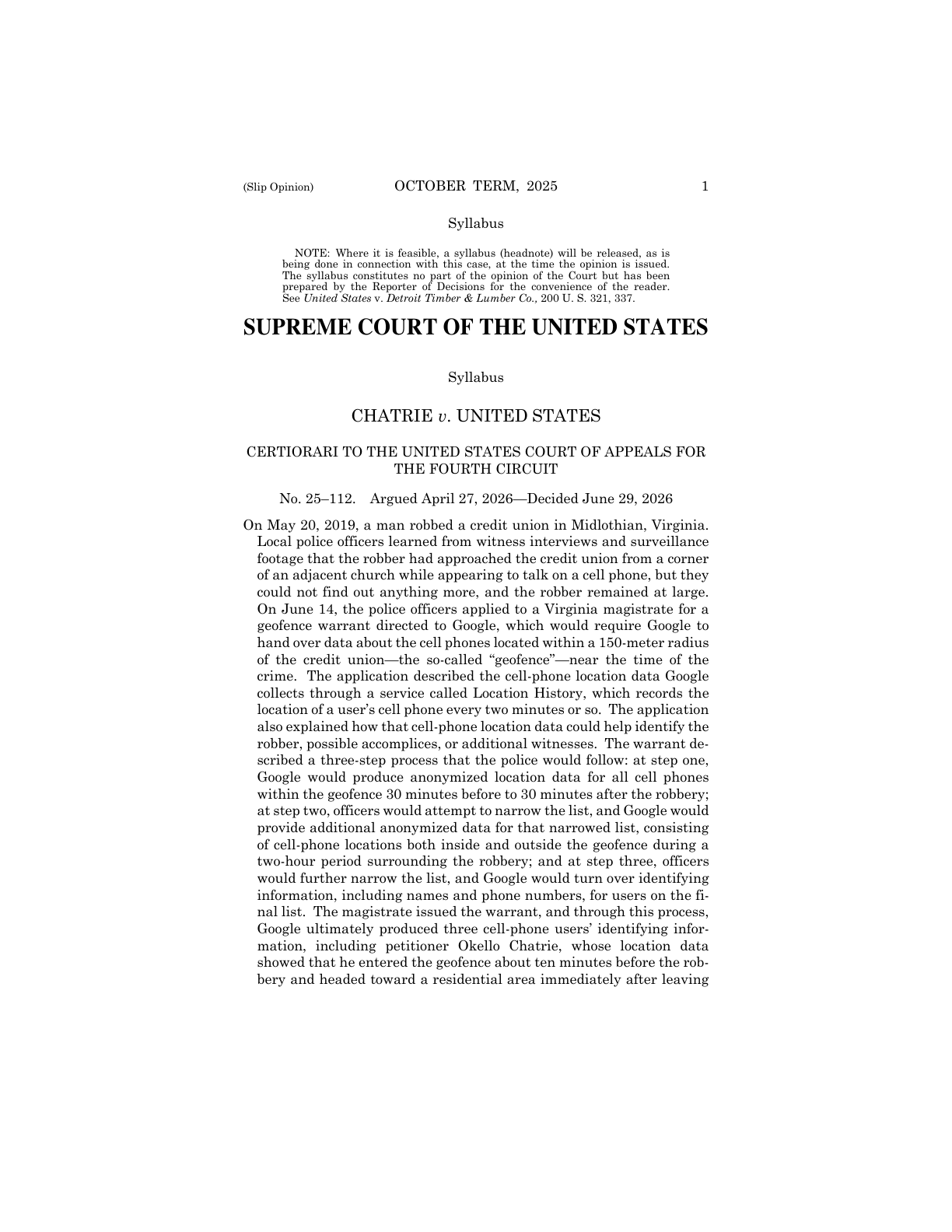
After a 2019 armed bank robbery in Virginia, police obtained a geofence warrant compelling Google to disclose the location data of all devices within a 17.5-acre area during the crime. Google produced anonymized data for all nearby devices, then — without additional judicial approval — was asked to deanonymize three devices, leading to the identification and arrest of Okello Chatrie. Chatrie moved to suppress, arguing the geofence warrant was an unconstitutional general warrant.
The Issue
Whether a geofence warrant compelling a technology company to disclose location data for all devices in a geographic area without particularized probable cause as to any individual violates the Fourth Amendment's particularity and probable cause requirements.
The Rules
No Warrants shall issue, but upon probable cause, supported by Oath or affirmation, and particularly describing the place to be searched, and the persons or things to be seized.
The government must generally obtain a warrant supported by probable cause before acquiring cell-site location information from a wireless carrier.
A person has no legitimate expectation of privacy in information voluntarily conveyed to a third party.
The Application
The government argues geofence warrants are constitutionally permissible investigative tools that satisfy the Fourth Amendment. The warrant specified a geographic area and timeframe tied to a specific crime, providing the judicial oversight the Constitution requires. Law enforcement needs modern digital tools to investigate crimes effectively.
Chatrie argues geofence warrants violate the Fourth Amendment because they compel disclosure of location data for every person in an area without particularized probable cause as to any individual. This is a digital general warrant: it sweeps up innocent people's private data to find a suspect, inverting the constitutional requirement that probable cause precede a search.
Argued April 27, 2026. The case extends Carpenter v. United States (2018) to geofence technology. Carpenter required a warrant for seven days of one person's cell-site data; Chatrie asks whether a warrant can authorize dragnet collection of everyone's data in an area. The ruling will define digital privacy rights for an era of pervasive location surveillance.
The Conclusion
The Supreme Court held 6-3 that executing a geofence warrant, which compels a provider to disclose location data for all devices near a crime scene, constitutes a Fourth Amendment search requiring probable cause. Justice Kagan wrote for the Court, extending the Carpenter framework to geofence warrants and vacating the conviction for remand.
No circuit court data for this case.
Flag an issue
This tracker is maintained by BrynoDC and is free because readers fund it. Support