
Federal Communications Commission v. AT&T, Inc.
Case Overview
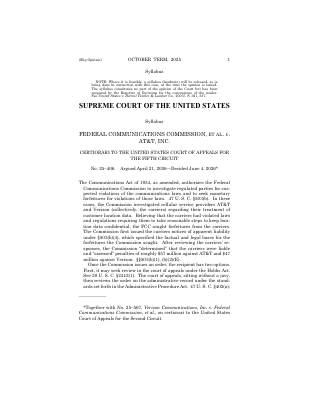
Decided June 4, 2026. The Supreme Court held that because forfeiture orders under 47 U.S.C. 503(b)(4) do not definitively resolve the parties' legal obligations and the FCC's factual findings are not conclusive, the FCC issuing forfeiture orders without a jury does not violate the Seventh Amendment.
Decision
BrynoDC Coverage 1 video
Opinion of the Court
The Facts
The FCC issued monetary forfeitures (fines) against AT&T and Verizon. Both companies argued they were denied their Seventh Amendment right to a jury trial because the FCC assessed and enforced the fines administratively, without a jury. The FCC argued the jury right is satisfied because the companies can either appeal the fine to a federal court or wait for the FCC to enforce the fine in court, at which point they would get a jury. The Supreme Court consolidated the cases to decide whether the FCC's administrative enforcement of monetary penalties is consistent with the Seventh Amendment and Article III.
The Issue
Whether the FCC's assessment and enforcement of monetary forfeitures against regulated companies are consistent with the Seventh Amendment's guarantee of a jury trial in civil cases and Article III's vesting of judicial power in the courts.
AT&T and Verizon argued that monetary forfeitures are analogous to common-law debt actions, which historically required jury trials, and that the FCC cannot impose fines through an administrative process that bypasses the courts entirely. The FCC argued that Congress can assign the adjudication of "public rights" to administrative agencies without violating the Seventh Amendment, and that regulated companies have adequate judicial review options.
The Rules
"In Suits at common law, where the value in controversy shall exceed twenty dollars, the right of trial by jury shall be preserved."
The judicial Power of the United States shall be vested in one supreme Court and in such inferior Courts as Congress may establish. Judges hold office during good behavior.
Authorizes the FCC to assess monetary forfeitures against regulated entities for violations of the Communications Act, FCC rules, or license terms.
Congress may assign adjudication of "public rights" to administrative agencies without jury trials, at least when the claims arise from a federal regulatory scheme that Congress created.
The Application
The Seventh Amendment preserves the right to a jury trial in civil suits "at common law." For most of American history, if the government wanted to collect a fine from a private party, it had to go to court. The party could demand a jury. But over the last century, Congress has built an enormous administrative state where agencies assess fines, hold hearings, and enforce penalties without ever entering a courtroom.
The public rights doctrine has been the main justification. When Congress creates a new regulatory scheme -- workplace safety, environmental compliance, communications licensing -- it can assign enforcement to an agency. The theory is that these are rights created by Congress, not rights that existed at common law, so the Seventh Amendment does not apply. But monetary fines look a lot like the debt actions that juries have decided since the founding.
This case is part of a broader reckoning with the administrative state's adjudicatory power. The Supreme Court has recently shown increased skepticism of agency adjudication in SEC v. Jarkesy (2024), where it held that the SEC cannot impose civil penalties through administrative proceedings when the defendant would have had a right to a jury trial at common law. The FCC cases test whether that principle extends to communications regulation.
The FCC's position is that its forfeiture process is different from SEC enforcement actions, and that regulated companies have adequate options: they can refuse to pay and force the FCC to sue in federal court, or they can appeal the fine to a federal appellate court. But AT&T and Verizon argue these workarounds do not satisfy the Seventh Amendment, which guarantees the right to a jury in the first instance, not just on appeal.
The stakes extend far beyond the FCC. Dozens of federal agencies assess monetary penalties administratively. If the Court holds that the Seventh Amendment requires a jury trial before the government can impose fines on regulated companies, it could reshape administrative enforcement across the federal government. Agencies from the EPA to the FTC to OSHA would need to rethink how they collect penalties.
The case also implicates Article III -- whether Congress can assign what amounts to judicial work to executive-branch agencies. The more the Court limits agency adjudication, the more enforcement moves back to the federal courts, which are already overburdened. The practical question is whether the constitutional principle is worth the institutional cost.
The Conclusion
**The FCC's authority to assess monetary forfeitures through administrative proceedings faces constitutional challenge under the Seventh Amendment and Article III.** The case tests whether the public rights doctrine survives the Court's recent skepticism of agency adjudication.
This is the next step after Jarkesy. If the principle extends beyond the SEC, administrative enforcement of monetary penalties across the federal government may require jury trials.
No circuit court data for this case.
Flag an issue
This tracker is maintained by BrynoDC and is free because readers fund it. Support