
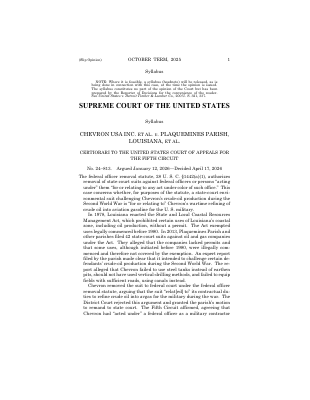
Chevron USA Inc. v. Plaquemines Parish, Louisiana
Case Overview
Chevron USA Inc. v. Plaquemines Parish addresses whether a wartime petroleum refiner can invoke government contractor immunity to defeat state environmental claims arising from World War II-era refining operations. Chevron refined aviation gasoline for the U.S. military under wartime directives and produced waste that contaminated Louisiana wetlands. Decades later, the Parish sued for environmental damage. Chevron asserts the Yearsley/Boyle government contractor defense shields it from state tort liability.
Decision
BrynoDC Coverage 2 videos
Opinion of the Court
The Facts
During World War II, Chevron refined crude oil into aviation gasoline for the U.S. military as part of the government's war production effort. Seventy years later, Plaquemines Parish and other Louisiana parishes sued Chevron in state court, alleging violations of Louisiana's Coastal Resources Management Act for crude oil production. The parishes claimed that Chevron's production methods—using earthen pits instead of steel tanks, using vertical drilling rather than other methods—lacked the required permits and did not qualify for the wartime exemption in the statute.
The Issue
Whether a state-court environmental suit against an oil company for crude oil production activities relates to the company's federal duties as a military contractor during wartime, such that the suit qualifies for removal under the federal officer removal statute.
Chevron argued that its crude oil production was necessary to perform its federal refining contract and thus "related to" federal duties. The Fifth Circuit held that the suit did not relate to federal duties because Chevron's refining contract did not specify how to obtain the crude oil.
The Rules
A state-court suit against a federal officer or person "acting under" federal officers can be removed to federal court if the suit is "for or relating to any act under color of such office." Federal contractors performing government duties may remove suits under this statute.
The phrase "relating to" sweeps broadly, meaning "to stand in some relation; to have bearing or concern; to pertain; refer; to bring into association with or connection with." A connection need not be direct.
A state-court suit relates to federal duties if the plaintiff challenges conduct that was necessary to perform the federal contract, even if the contract itself did not specify the methods or materials required.
The Application
The federal officer removal statute exists to protect federal contractors and officials from hostile state-court litigation over their federal duties. If a military contractor can be sued in state court for activities integral to war production, federal decision-making gets entangled in state courts. During World War II, crude oil was essential to aviation fuel production. Chevron's refining contract was with the federal government to produce avgas. Without crude oil, Chevron could not perform that contract. Yet the Fifth Circuit found that the parishes' suit did not relate to federal duties because the refining contract did not specify how Chevron should obtain crude oil. That distinction proved too technical.
The Supreme Court focused on what "relating to" means. The term sweeps broadly—it means standing in some relation, having bearing or concern. Crude oil was indispensable to avgas. You cannot refine oil into aviation fuel without raw crude oil. The parishes challenged Chevron's crude oil production methods, claiming they violated state environmental law. That suit relates to federal duties because the very subject matter—how to obtain and process crude oil—was central to Chevron's federal contract. The fact that the refining contract did not explicitly address crude sourcing does not break the connection. Federal duty performance often involves decisions not spelled out in the contract.
The Conclusion
**The Supreme Court held that Chevron had plausibly alleged a close relationship between its crude oil production and its federal avgas refining duties, satisfying the "relating to" requirement for federal officer removal.** The Fifth Circuit's judgment was reversed and remanded. States cannot use environmental law to second-guess federal contractors' performance of wartime military duties through hostile state litigation.
The decision protects federal contractors from balkanized state-court challenges to federal decision-making. Where federal duties exist and state law threatens them, the Supremacy Clause and the removal statute ensure that federal courts, not state courts, referee the dispute.
Concurrences
Concurrence — Justice Ketanji Brown Jackson
Jackson agreed with the judgment but emphasized that the statute requires a direct link where the federal duty caused the action, rather than just any broad association with federal work.
No circuit court data for this case.
Flag an issue
This tracker is maintained by BrynoDC and is free because readers fund it. Support