
Pitchford v. Cain
Case Overview
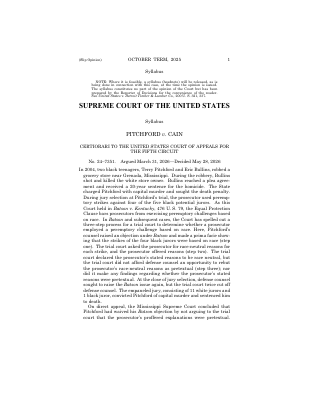
Terry Pitchford was 18 years old and Black when he was convicted of capital murder in Mississippi in 2004 — the co-defendant who actually pulled the trigger was a minor and got 20 years. The prosecution struck four of the five Black potential jurors. His lawyers raised a Batson objection — the rule from Batson v. Kentucky that prohibits striking jurors because of their race — but the trial judge stopped at Step 2 of Batson's three-step process: he accepted the prosecution's race-neutral explanations without letting the defense respond and without making any finding on whether those explanations were pretextual. Pitchford has been on death row for 20 years. The Mississippi Supreme Court called his failure to object further a waiver. The U.S. Supreme Court reversed 5-4 on May 28, 2026, with Justice Kavanaugh writing for a majority that included Chief Justice Roberts and the three liberal justices: you cannot waive a right to a ruling that was never made. The decision sends Pitchford back to the lower courts and is significant because the same prosecutor, Doug Evans, was already caught running the same pattern across six trials in Flowers v. Mississippi in 2019.
Decision
5-4BrynoDC Coverage 1 video
Opinion of the Court
The Facts
In 2004, two black teenagers, Terry Pitchford and Eric Bullins, robbed a grocery store in Grenada, Mississippi, and shot and killed the store owner. While some facts are slightly unclear, the record shows that 18 year old Pitchford may have fired somewhere in the store (possibly at the floor), but 16 year old Bullins fired all three shots that killed the store owner.
Bullins, a minor, signed a plea deal and was given a 20 year sentence. Pitchford, who did not agree to a deal, was convicted of capital murder and sentenced to death, despite not actually shooting the store owner.
Pitchford’s Trial
During Pitchford’s trial, prosecutor Doug Evans, already repeatedly admonished by the Supreme Court for race based jury selection in another case, used peremptory challenges to remove 4 of the 5 potential black jurors.
Pitchford’s attorney objected at trial under Batson, but the judge said that the prosecution’s alternate and race neutral explanations for dismissing the jurors, including “returning to court 15 minutes late,” and being a “young unmarried father,” were acceptable, and without giving the attorney a chance to rebut, moved on to the next trial issue. At the end of jury selection the defense attorney renewed their Batson objection but was again rebuffed.
The record seems to indicate that when pressed, the trial judge assured the objecting defense counsel that the “issues were preserved” for the record.
The Mississippi Supreme Court upheld the conviction, finding that the defense counsel had not properly preserved the issue and that the objection was therefore waived. Mississippi claims this is compliant with state precedent. Pitchford sought federal habeas relief, arguing the state court’s acceptance of the race-neutral explanations, and refusal to hear the claim in light of the alleged waiver, was objectively unreasonable.
Peremptory Challenges
Each jurisdiction has its own rules for the choosing a jury. But generally, a juror may be removed from the pool, “for cause,” generally a specific reason that this juror cannot perform their duty. A juror can also be removed using a peremptory challenge, usually a limited number of unexplained removals from the jury pool allowed to each lawyer.
Peremptory challenges have special rules to prevent their use as a pretext for race based exclusion from the jury pool.
The Issue
Were the prosecution’s peremptory challenges to all Black members racially discriminatory in violation of Batson v. Kentucky (1986)? Do Mississippi state precedents violate federal law? Even if the state precedent does demonstrate a “waiver,” does the effort of the prosecutor on the record to subject, and the court’s insistence that the issue was preserved, render Mississippi’s decision unreasonable?
The Rules
Race-based peremptory strikes violate the Equal Protection Clause and require prosecutors to provide a race-neutral justification when challenged. The trial court then decides whether the explanation is pretextual.
Federal courts cannot overturn state court rulings unless the decision was "contrary to, or involved an unreasonable application of, clearly established Federal law" or was based on an unreasonable determination of the facts. The standard is not whether the decision was wrong, but whether it was objectively unreasonable.
When evaluating Batson claims, courts should consider the totality of the circumstances, including a prosecutor's history of striking minority jurors across cases.
The Application
The AEDPA makes these sort of challenges very tough. States are given a lot of leeway to make decisions in this arena and federal courts have limited options to overturn them.
Mississippi has its own rules about how to interpret a Batson objection and when the objection is waived. But even if it was technically waived according to Mississippi, two questions remain.
1) Does Mississippi’s precedent on waiver violate federal law? 2) Even with a waiver, did the lawyers repeated objections, followed by an assertion by the court that the objection had in fact been recorded, make Mississippi’s conclusion unreasonable?
Batson v. Kentucky is one of the most important criminal procedure decisions of the 20th century. It prohibits prosecutors from using peremptory challenges to remove jurors based on race.
The problem is enforcement. The race-neutral explanations prosecutors offer are often thin, a juror seemed “nervous,” did not make eye contact, or had a relative with a criminal record. Trial courts often accept them. Leaving the decision to be made in an appeal, rooted in the objection made by counsel at the time.
By the time the case reaches federal habeas review, AEDPA’s deference standard makes it nearly impossible to overturn: the federal court must find not just that the state court was wrong, but that it was objectively unreasonable.
In the law, states are often called laboratories of democracy, each of the fifty, allowed to brew its own special sauce, within certain limits. The death penalty is a controversial topic. Should a government take a human life. But this question has been largely left to each state to determine for itself in this grand experiment. It is for this reason that a law like the AEDPA makes the court’s intervention into a state capital case so difficult to achieve.
For federal habeas purposes, the question is not whether the prosecutor’s explanations were convincing, it is whether any reasonable jurist could have believed them.
That double layer of deference (deference to the trial court’s credibility finding, then AEDPA deference to the state appellate court’s review of that finding) creates a nearly insurmountable barrier in state capital Habeas cases. The result is that Batson’s promise of race-neutral jury selection can be effectively unenforceable in practice, even when the pattern of strikes strongly suggests racial motivation.
Lawyers are held to a standard of “zealous representation” of our clients. We are required to step on toes and push the envelope to make sure our clients needs are met.
There as a discussion at oral arguments over whether Pitchford’s attorney met that standard. Looking at the exact moments of objection, when the attorney allowed the judge to continue, etc., did the lawyer do their job?
The justices, many with court room experience on both sides of the bench had an interesting back and forth in this topic. Could the lawyer have done more to demand that the client’s objections were heard? Counterpoint, at what point does angering a judge with repeated objections that the judge says have been recorded, begin to hurt your client’s standing with the judge?
Ultimately Kavanaugh gets stuck on one logical impossibility. Either Pitchford preserved his Batson objection, as Mississippi states that he did, or he waived his Batson objection, as Mississippi also states. He cannot simultaneously do both.
With this logical stalemate, Kavanaugh says, Mississippi’s argument is patently and undeniably unreasonable.
The Conclusion
**The Supreme Court reversed 5-4, holding that Pitchford could not have waived his right to a Batson ruling that was never made.** Justice Kavanaugh, joined by Roberts, Sotomayor, Kagan, and Jackson, sent the case back to lower courts for a proper Step 3 determination on whether the prosecution’s strikes were pretextual. Pitchford remains on death row pending remand.
Dissent — Gorsuch, J.
Deference to Mississippi
Unlike the majority, Gorsuch begins and ends with the precedents deferring to states to fashion their own rules for preserving Batson claims. As such, Mississippi’s reliance on the standards it has created is reasonable. The rule that Mississippi has adopted is that any Batson argument not adequately presented at trial is waived.
Gorsuch on the Facts
Gorsuch sees two objections occurring in the facts. First, the defense objected to the peremptory challenges, giving rise to a Batson hearing. Then, in Gorsuch’s view, all three steps of the Batson rules were met. And when the third step was announced by the judge, accepting the prosecution’s race-neutral explanation, the defense counsel didn’t object. It wasn’t until later when the court said that jury selection was over that the defense renewed its objection. Whether or not the SCOTUS feels that the defense counsel objected enough, the Mississippi court did not. Gorsuch did not feel, under the circumstances and the factual record, that this conclusion was unreasonable.
The Statutory Standard
The AEDPA has a very strict standard before overturning state court decisions in Habeas. The decision of the state court must be so unreasonable that “no fair minded jurist could reach the state’s conclusion.” So legal error, reasonable minds disagreeing, according Gorsuch, none of that is enough in this case. The standard is high and Pitchford just doesn’t reach it.
No circuit court data for this case.
Flag an issue
This tracker is maintained by BrynoDC and is free because readers fund it. Support