
Enbridge Energy, LP v. Nessel
Case Overview
Enbridge Energy, LP v. Nessel addresses whether Michigan's lawsuit seeking to shut down the Line 5 pipeline crossing the Straits of Mackinac belongs in federal or state court. Enbridge argues federal admiralty jurisdiction and federal pipeline law make the dispute a federal matter subject to removal. Michigan contends it filed a state-law easement enforcement claim. The case tests the limits of federal removal jurisdiction in pipeline disputes with significant interstate energy implications.
Decision
Opinion of the Court
The Facts
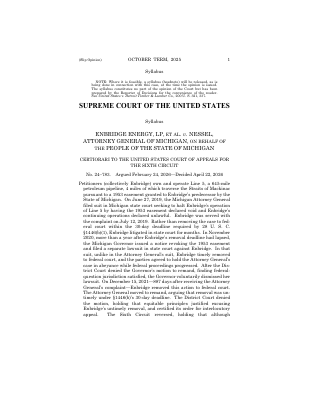
Enbridge operates Line 5, a 645-mile petroleum pipeline with 4 miles crossing Michigan's Straits of Mackinac under a 1953 easement. In June 2019, Michigan's Attorney General sued in state court seeking to void the easement and shut down operations. Enbridge received the complaint on July 12, 2019, but did not remove the case to federal court within the required 30 days, missing the statutory deadline by months.
The Issue
Whether a federal court's removal-deadline rule under 28 U.S.C. §1446(b)(1) is subject to equitable tolling, allowing late removal when a defendant has good cause for the delay.
Enbridge argued that the 30-day removal window should be subject to equitable tolling because the deadline is not strictly jurisdictional. Michigan argued that the statute's plain language permits no exceptions, and the deadline must be strictly observed to protect state court authority.
The Rules
A civil action commenced in state court may be removed by a defendant within 30 days after receipt of initial pleading. The deadline is mandatory and not subject to equitable tolling under the plain text of the statute.
Jurisdictional requirements cannot be waived or forfeited and do not allow for equitable exceptions. But nonjurisdictional time limits may still be mandatory and not susceptible to equitable tolling.
The fact that a deadline lacks jurisdictional force does not render it malleable. Some nonjurisdictional rules remain mandatory and are not susceptible to equitable tolling.
The Application
The removal statute has always been strict. Congress wrote it to say defendants get 30 days to move a case to federal court, with two narrow exceptions: Confederated Tribes (foreign sovereignty) and Avco (ERISA preemption). When the statute says 30 days, courts have historically read it as 30 days—no more. The statute serves a purpose: state courts get finality, federal diversity jurisdiction flows from state court authority rather than defendant whim, and predictability reigns. If Enbridge could show up six months later and remove on the theory that equitable tolling applies, state courts would lose control over their own dockets.
Enbridge's argument had surface appeal: the deadline is not technically jurisdictional (removing a case doesn't violate Article III or statutory grant of federal jurisdiction), so why shouldn't equitable tolling apply? But the Court had made clear in Boechler that nonjurisdictional rules can still be mandatory. A rule can be nonjurisdictional but still absolutely binding—like a procedural bar on filing or a statute of limitations. The §1446(b)(1) deadline is that kind of rule. It is procedural, binding, and not waivable by equitable exception. The text says 30 days. The 30 days are up. Late removal fails.
Enbridge also argued that the removal statute had developed a split among the Courts of Appeals: some allowed equitable tolling, others did not. The grant of certiorari was to resolve the split. But resolving a split does not require accepting the more permissive rule. The Court unified the law by holding that equitable tolling does not apply. The deadline is absolute. This protects state court authority and prevents defendants from gaming removal timing.
The Conclusion
**The Supreme Court held that the 30-day removal deadline under §1446(b)(1) is not subject to equitable tolling.** Because Enbridge missed the deadline, its removal was untimely and the case must proceed in state court. The judgment was affirmed, preserving Michigan's authority to litigate the easement dispute in its own courts.
The decision reaffirms that federal removal statutes are to be read strictly and narrowly. While removal jurisdiction is broadly construed to encompass all removable cases, the procedural requirements for removal are rigorous. Miss the deadline, and you stay in state court.
No circuit court data for this case.
Flag an issue
This tracker is maintained by BrynoDC and is free because readers fund it. Support