
Rutherford v. United States
Case Overview
Daxton Rutherford received a 25-year mandatory minimum sentence in 2003 under a federal law that stacked firearm charges on top of drug charges, a provision Congress itself later acknowledged was too harsh and changed in the First Step Act of 2018 — but not retroactively. Rutherford asked for compassionate release, arguing that serving a sentence Congress had deemed unjust qualifies as an extraordinary and compelling circumstance that courts can act on. The Supreme Court disagreed: Congress's deliberate choice not to make the fix retroactive is itself the answer to whether sentences under the old law are extraordinary, not a reason to get around it. Bryan covers it as a case about what 'compassionate release' actually covers, and as an illustration of the gap between Congress acknowledging a law was wrong and actually fixing it for the people already inside.
Decision
6-3BrynoDC Coverage 1 video
Opinion of the Court
The Facts
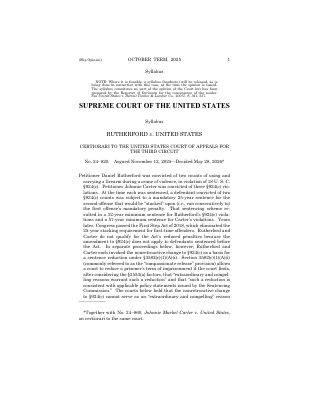
Daniel Rutherford was 25 years old when he committed two armed robberies in 2003, stealing a watch and about $1,300 in jewelry and cash. No shots were fired. Because he carried a gun during each robbery, he got stacked mandatory minimums under federal law: 7 years for the first count, then a mandatory 25 years on top of that for the second. Total sentence: over 42 years. Congress fixed that stacking rule in 2018, when it passed the First Step Act. Under the new law, Rutherford would have faced 14 years. But Congress didn't make the fix retroactive, so Rutherford kept serving his 42-year sentence and asked a federal court for compassionate release.
The Issue
The legal question: when Congress changes a sentencing law but specifically declines to apply the change to people already sentenced, can a prisoner use that exact disparity as the "extraordinary and compelling reason" required to get compassionate release?
Rutherford's side said yes. The gap between what he got and what he would get today is stark, Congress itself recognized the old sentences were too harsh, and district judges have always had discretion to weigh the totality of a person's circumstances. The government said no. Congress made a deliberate choice to leave old sentences intact, and courts can't treat that choice as a reason to undo it. Barrett and five other justices agreed with the government.
The Rules
Required a mandatory 25-year consecutive sentence for each firearms count after the first, resulting in sentences that stacked automatically even for first-time offenders convicted together.
Eliminated the 25-year stacking requirement for first-time offenders; the enhanced minimum now applies only to a "violation that occurs after a prior conviction under this subsection has become final." Congress expressly did not make the change retroactive.
A court may reduce a sentence if it finds that "extraordinary and compelling reasons warrant such a reduction" and that the reduction is consistent with applicable policy statements from the Sentencing Commission.
Added a new ground for compassionate release: an unusually long sentence where a "change in the law . . . would produce a gross disparity" between the sentence being served and what would be imposed today, after at least 10 years served and "full consideration of the defendant's individualized circumstances."
When Congress extends revised criminal penalties to defendants not yet sentenced but withholds them from those already sentenced, "an unexceptional feature of a system in which nonretroactivity is the default" results, not an unusual injustice.
Empowers the Sentencing Commission to issue policy statements "describ[ing] what should be considered extraordinary and compelling reasons," with one hard limit: "[r]ehabilitation of the defendant alone shall not be considered an extraordinary and compelling reason."
The Application
Congress had a problem it knew about for years. The way §924(c) was written, a defendant convicted of two gun counts in a single case got hammered twice: 7 years mandatory for the first, then 25 years mandatory, consecutive, for the second. A repeat offender who committed two separate crimes over time faced the same math. Congress eventually decided that was too severe for first-timers caught up in a single case, and it fixed the rule in the First Step Act of 2018.
The problem was the fix only applied going forward. People who had already been sentenced, like Rutherford, stayed right where they were. That left a two-tier system: one group serving sentences everyone agreed were too harsh, another group sentenced under the corrected law. For Rutherford, the gap was 28 years. For his co-petitioner Johnnie Carter, who had three stacked counts from a 2007 bank robbery spree, the gap was 36 years. Carter's co-conspirators who took plea deals got 10 to 23 years. Carter got 70.
Compassionate release is the mechanism Congress created for courts to reduce a sentence mid-term when circumstances warrant. Before 2018, only the Bureau of Prisons could trigger it. The First Step Act opened the door for prisoners to file directly. Rutherford and Carter walked through that door and argued the sentencing disparity created by Congress's own fix was the extraordinary and compelling reason they needed.
The Sentencing Commission backed them up. In 2023, the Commission amended its guidelines to add "unusually long sentence" as a recognized ground for compassionate release, specifically allowing courts to consider nonretroactive changes in law when those changes would produce a "gross disparity." That amendment was the formal policy vehicle for the argument Rutherford and Carter were making.
Barrett's majority opinion starts with the dictionary, and it goes from there to a structural argument that forecloses the petitioners' entire theory. "Extraordinary" means far from common, having little or no precedent. "Compelling" means convincing, demanding attention, hard to resist. Put them together, and you need something that is both especially unusual and genuinely convincing.
The problem for Rutherford, the Court said, is that nonretroactive sentencing changes are not extraordinary at all. They are the default. Federal law has always operated on the assumption that new criminal penalties apply to future offenders, not past ones. Congress deviated from that default in the First Step Act by extending the fix to people not yet sentenced. But that deviation made nonretroactivity for people already sentenced even more deliberate, not less. Congress looked at the situation, decided to help some people, and chose not to help others. That is not an unusual circumstance. That is standard operation.
Then there is the "compelling" problem. A compelling reason is one that convinces you to act. The majority asked: how can Congress's deliberate decision to leave a sentence intact be a convincing reason for a court to undo it? The court would be treating Congress's choice as a reason to override Congress's choice. That, Barrett wrote, makes no sense. It would "undermine Congress's choice to leave the sentence intact" at the exact moment the court purports to respect it.
The majority also drew a line around what compassionate release has historically been for. Medical crises. Terminal illness. A family left with no one else to care for children. The statute grew out of a Bureau of Prisons practice that was almost entirely about inmates who were dying. Sentencing disparities from legislative changes are a different category entirely. They are not about the prisoner's personal circumstances; they are about a policy judgment Congress made and deliberately limited. Expanding the heartland of compassionate release that far, the Court said, would give district judges a standing invitation to second-guess any mandatory minimum they thought was too harsh.
Sotomayor's dissent is direct: Congress told the Sentencing Commission to define "extraordinary and compelling," the Commission did exactly that, and the majority just threw the Commission's work out the window. Under the statute, Congress delegated the definitional work to the Commission. The Court's role, Sotomayor argued, was the modest one: make sure the Commission didn't act unreasonably within its authority. Instead, the majority conducted its own independent interpretation and used that to invalidate the Commission's policy.
The dissent also challenged the majority's logic on what counts as extraordinary. Age is an ordinary fact. Getting sick is ordinary. Family hardship is ordinary. The whole point of the "extraordinary and compelling" inquiry is that ordinary facts, in combination, can add up to something extraordinary. The Commission's framework recognized that. It required a prisoner to show an unusually long sentence, at least 10 years already served, a gross disparity, and full consideration of individualized circumstances. In FY 2024, that combination produced relief in exactly 98 cases out of more than 130,000 people in federal custody. That is not a floodgate. That is a narrow opening.
The dissent's sharpest point may be the §3553(a) anomaly. Federal sentencing law already requires courts to consider "the need to avoid unwarranted sentence disparities" as one of the factors they weigh when imposing or modifying a sentence. The government conceded at argument that courts can consider nonretroactive sentencing changes at the discretion stage once a prisoner clears the "extraordinary and compelling" gate. Sotomayor argued that makes the majority's rule incoherent: a disparity is relevant once you're eligible for relief but cannot be considered in deciding whether you're eligible. She called that arrangement illogical, and she has a point that will follow this holding into future litigation.
The Conclusion
**The Court held 6-3 that a nonretroactive change in sentencing law cannot serve as an extraordinary and compelling reason for compassionate release, even when the gap between the old and new sentence is measured in decades.** The ruling invalidates the Sentencing Commission's 2023 guideline to the extent it allows courts to consider such disparities, and locks in a two-tier system for people sentenced before and after the First Step Act.
No circuit court data for this case.
Flag an issue
This tracker is maintained by BrynoDC and is free because readers fund it. Support